












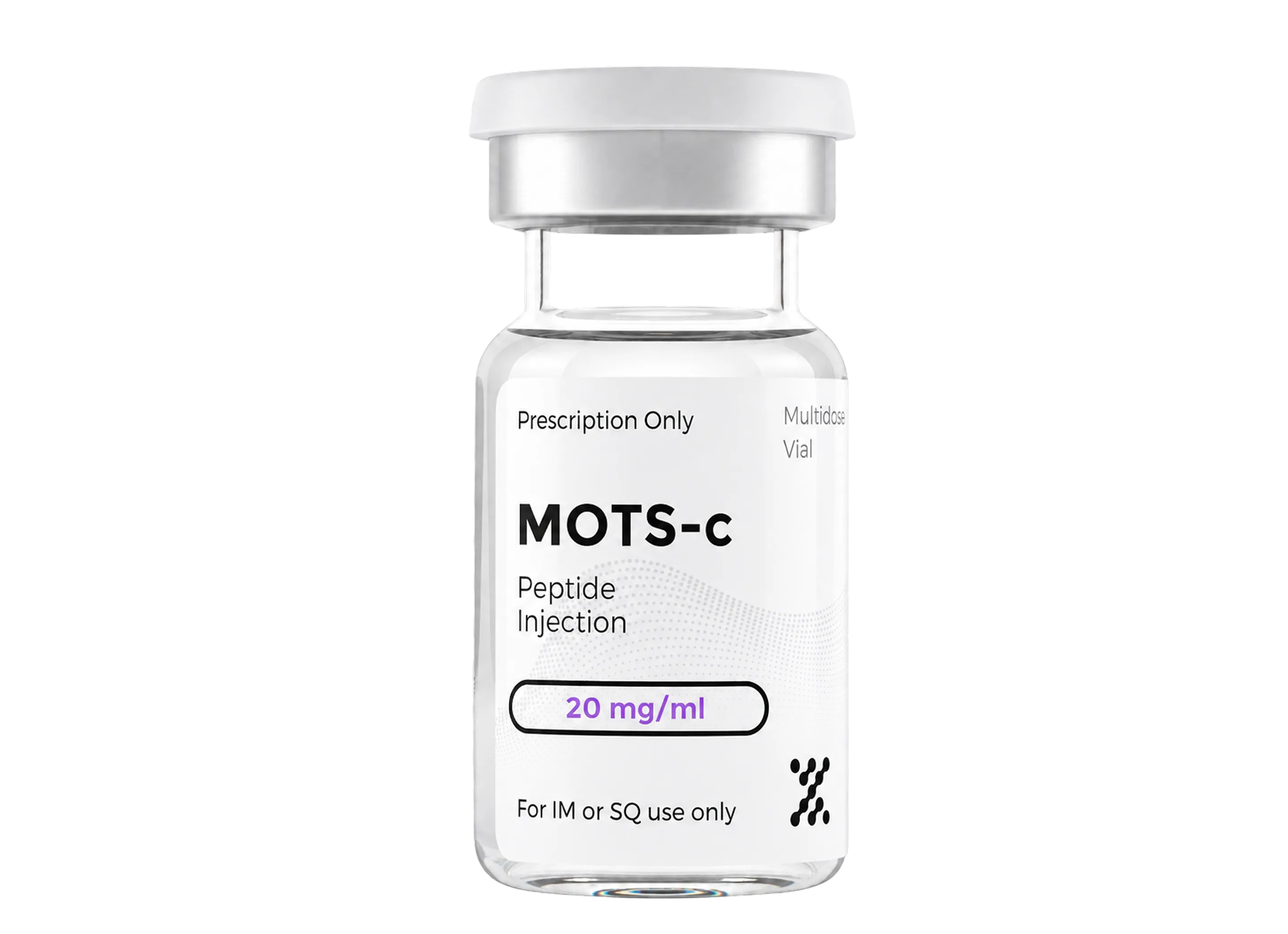
MOTS-c (mitochondrial open reading frame of the 12S rRNA type-c) is a 16-amino-acid peptide encoded by the DNA inside your mitochondria, the energy-producing structures in every cell. Unlike most peptides, which come from the cell’s nuclear DNA, MOTS-c is one of a small group of “mitochondrial-derived peptides” that help regulate how the body uses glucose and fat for energy. Natural MOTS-c levels rise with exercise and decline with age, which has made it a focus of research on metabolic health, insulin sensitivity, and physical decline. MOTS-c is a compounded peptide and requires a prescription from a licensed physician. At REGENX Health, all MOTS-c prescriptions are managed by a board-certified urologist for qualified candidates seeking therapy.
Benefits of MOTS-c
MOTS-c acts mainly on skeletal muscle, where it activates AMPK, the cell’s central energy sensor. AMPK is the same pathway switched on by exercise and by the diabetes medication metformin. In animal studies, MOTS-c treatment prevented diet-induced obesity and insulin resistance (see the original Cell Metabolism study), and in older mice it improved physical performance. Research suggests MOTS-c may support the following:
- Improved insulin sensitivity and glucose uptake in skeletal muscle
- Reduced fat gain and support for fat loss, including visceral fat
- Increased fat oxidation and metabolic flexibility
- Improved physical capacity and exercise performance with age
- Support for mitochondrial function and cellular stress resistance
- Healthier liver enzyme and liver fat markers (seen with a MOTS-c analog in early human testing)
MOTS-c Dosage and Formulations
REGENX Health offers, through licensed US compounding pharmacies, compounded MOTS-c as a sterile injectable. Your board-certified urologist determines the dose and schedule based on your labs, metabolic health, body composition goals, and candidacy for therapy.
MOTS-c Vial (20mg/mL)
A multi-dose injectable vial containing MOTS-c at a concentration of 20mg/mL, for subcutaneous injection. Because there is no FDA-approved MOTS-c product and no established human dosing guideline, your physician sets the dose, frequency, and cycle length individually and adjusts them based on your response and follow-up labs as indicated. MOTS-c protocols are commonly run in defined cycles with injections a few times per week rather than every day.
Risks and Side Effects of MOTS-c
Human safety data for MOTS-c are limited. In a small early-stage study of CB4211, an investigational MOTS-c analog, the only adverse events seen in more than 10% of participants were mild to moderate injection site reactions, with no serious adverse events over four weeks (see the CB4211 Phase 1b results). CB4211 is a modified version of MOTS-c, so these results may not fully apply. All use requires physician supervision and informed consent.
Possible Side Effects
- Injection site reactions (redness, mild swelling, itching, or soreness)
- Fatigue or mild lethargy, typically early in a cycle
- Headache or lightheadedness
- Lower blood glucose, particularly in men taking diabetes medications
- Changes in appetite
Important Considerations
- MOTS-c is not FDA-approved for any condition and is prescribed as a compounded peptide. Long-term safety data in humans are not yet established.
- Most of the evidence for MOTS-c comes from animal and cell studies. During every consultation, the potential benefits, risks, and limits of the current evidence are discussed in detail with the patient.
- MOTS-c works on the same energy pathway as exercise. It is intended to support, not replace, a consistent training and nutrition plan.
- MOTS-c acts as an AMPK-activating metabolic modulator, a class prohibited by the World Anti-Doping Agency (WADA). Competitive athletes subject to drug testing should not use it.
- Regular check-ins with your prescribing physician are required to assess response and safety throughout the course of treatment.
How Do You Take MOTS-c
Subcutaneous Injection
MOTS-c is administered as a subcutaneous injection. Draw the prescribed dose using a standard insulin syringe, then inject it into a clean subcutaneous site such as the abdomen, outer thigh, or glute area.
Frequency
MOTS-c is typically injected a few times per week in cycles of several weeks, followed by a break. Your urologist will advise on your exact schedule and treatment duration throughout management and follow-up visits.
Timing
Many patients inject in the morning or before a workout, since MOTS-c acts on the same energy pathways activated by exercise. Consistency in timing is more important than the specific time of day.
Storage
Keep the vial refrigerated and protected from light. Do not freeze. Follow the beyond-use date on your pharmacy label.
Injection Sites
Rotate injection sites to avoid irritation and lipodystrophy. Common sites include the lower abdomen (2 inches from the navel), outer thigh, and gluteal fat. Clean each site with an alcohol swab and allow it to dry before injecting.
Who Can Use MOTS-c
- Men with insulin resistance or early metabolic changes, such as elevated fasting glucose or HbA1c
- Men with excess body fat, particularly abdominal or visceral fat, who want metabolic support alongside diet and exercise
- Men noticing an age-related decline in energy, endurance, or exercise capacity
- Active men who want to support metabolic flexibility and recovery between training sessions
- Men on testosterone replacement therapy (TRT) who want to add a metabolic-focused peptide to their protocol
- Men with elevated liver enzymes or fatty liver markers who are working with their physician on metabolic health
Who Should Not Take MOTS-c
- Men with active cancer or under active cancer treatment, given the limited human safety data
- Men taking insulin or sulfonylureas without close physician monitoring, due to the potential for low blood sugar
- Men with a history of frequent or severe hypoglycemia
- Competitive athletes subject to WADA or similar anti-doping regulations
- Individuals with known hypersensitivity to any component of the compounded formulation
- Anyone not under direct physician supervision, as MOTS-c requires a prescription and medical monitoring
What Do You Need to Monitor on MOTS-c
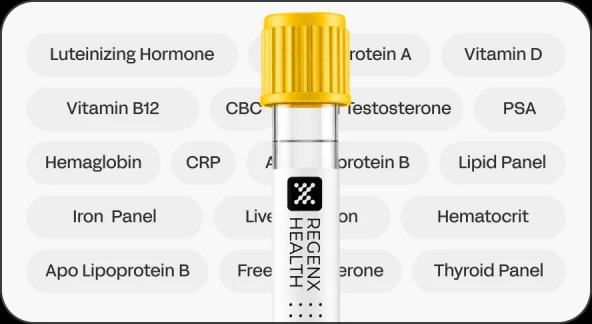
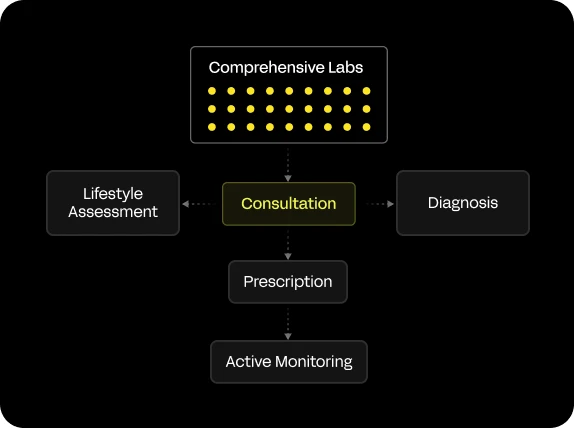
REGENX Health uses a lab-guided approach throughout every peptide protocol. Your board-certified urologist reviews your lab values before starting therapy and at scheduled intervals to track response and safety.
- Fasting Glucose and HbA1c: Track blood sugar control and response to therapy
- Fasting Insulin: Assess insulin resistance at baseline and over time
- Lipid Panel: Monitor cholesterol and triglycerides as metabolic health changes
- CMP (Comprehensive Metabolic Panel): Liver enzymes (ALT, AST) and kidney function
- CBC (Complete Blood Count): Assess baseline blood health
- Total and Free Testosterone: Baseline and periodic monitoring for all men, especially those on concurrent TRT
- PSA (Prostate-Specific Antigen): Included in the standard REGENX Health panel for all male patients
- Body Composition: Weight, waist circumference, and body fat to track visceral fat and lean mass
Clinical Research on MOTS-c
The following research supports the clinical rationale for MOTS-c. All studies are reviewed for relevance by the REGENX Health clinical team.
- The Mitochondrial-Derived Peptide MOTS-c Promotes Metabolic Homeostasis and Reduces Obesity and Insulin Resistance (Lee et al., 2015) - The discovery study. Identified MOTS-c, showed it targets skeletal muscle and activates AMPK, and found that MOTS-c treatment prevented diet-induced obesity and insulin resistance in mice.
- MOTS-c Is an Exercise-Induced Mitochondrial-Encoded Regulator of Age-Dependent Physical Decline and Muscle Homeostasis (Reynolds et al., 2021) - Found that exercise raises MOTS-c levels in human skeletal muscle and circulation, and that MOTS-c treatment improved physical performance in young, middle-aged, and older mice.
- MOTS-c: A Novel Mitochondrial-Derived Peptide Regulating Muscle and Fat Metabolism (Lee et al., 2016) - Reviewed how MOTS-c regulates glucose and fat metabolism in muscle and fat tissue, positioning it as a potential target for metabolic disease and aging.
- Mitochondria-Derived Peptide MOTS-c: Effects and Mechanisms Related to Stress, Metabolism and Aging (2023) - A review of MOTS-c’s roles in cellular stress responses, metabolism, and age-related conditions, summarizing the current preclinical and human observational evidence.
- CohBar Phase 1a/1b Study of CB4211, a MOTS-c Analog, in Obese Adults With NAFLD (2021) - In 20 obese adults with fatty liver disease, four weeks of daily CB4211 lowered ALT by 21% and AST by 28% and reduced glucose by 6% versus placebo, with mild injection site reactions as the most common side effect.
Frequently Asked Questions About MOTS-c Vial
What is MOTS-c?
MOTS-c is a 16-amino-acid peptide encoded by mitochondrial DNA rather than the cell’s nuclear DNA. It acts mainly on skeletal muscle, where it activates AMPK, a key regulator of how the body uses glucose and fat. At REGENX Health, MOTS-c is prescribed as a compounded injectable peptide for qualified men seeking metabolic support.
What are the benefits of MOTS-c?
Research suggests MOTS-c may improve insulin sensitivity, support fat loss, increase fat oxidation, and help maintain physical capacity with age. Most of this evidence comes from animal studies, and early human data with a MOTS-c analog showed improvements in liver enzymes and glucose. Results in people are still being studied.
Is MOTS-c an “exercise mimetic”?
MOTS-c is sometimes called an exercise mimetic because exercise naturally raises MOTS-c levels and both activate the same AMPK energy pathway. However, MOTS-c does not replace exercise. It is best viewed as a tool to support the metabolic benefits of a consistent training and nutrition plan.
How is MOTS-c administered?
MOTS-c is given as a subcutaneous injection using a standard insulin syringe, typically into the abdomen, outer thigh, or glute. Most protocols involve injections a few times per week in defined cycles. Your REGENX Health physician will advise the dose and treatment duration at your consultation.
What are the side effects of MOTS-c?
The most commonly reported effects are mild injection site reactions and temporary fatigue early in a cycle. Because MOTS-c influences glucose metabolism, men taking diabetes medications need closer monitoring for low blood sugar. Human safety data are limited, which is why physician supervision and regular lab monitoring are required.
Do I need a prescription for MOTS-c?
Yes. MOTS-c is not FDA-approved and is prescribed as a compounded peptide through a licensed physician. At REGENX Health, a board-certified urologist evaluates your labs and medical history before prescribing and manages your protocol from start to finish.
How is MOTS-c different from semaglutide or tirzepatide?
Semaglutide and tirzepatide are FDA-approved GLP-1-based medications that reduce appetite and slow digestion, with large clinical trials behind them. MOTS-c works differently: it acts on muscle energy metabolism through AMPK rather than on appetite, and its human evidence is still early. Your physician can explain which approach, or combination, fits your goals.
Can MOTS-c be combined with TRT or other peptides?
Yes, MOTS-c is sometimes added to a testosterone replacement therapy protocol or used alongside other peptides as part of a broader metabolic plan. Your physician adjusts lab monitoring to track all active therapies and check for overlap or interactions.
How long does it take to see results from MOTS-c?
Some men report changes in energy and exercise tolerance within the first few weeks. Changes in body composition and metabolic labs such as glucose and insulin are typically assessed after one to three months. Results vary based on starting metabolic health, training, nutrition, and individual response.
What does MOTS-c cost?
Pricing depends on your dose, injection frequency, and cycle length. MOTS-c is included in REGENX Health’s peptide catalog and is discussed during your consultation. Because it is a compounded prescription, cost is separate from insurance coverage in most cases. Contact REGENX Health directly for current pricing and to confirm whether your HSA/FSA can be applied.
Where can I get a MOTS-c prescription near me?
REGENX Health operates as a fully virtual practice, so you don’t need to find a clinic near you. Your initial consultation with a board-certified urologist is conducted via Zoom. Once your labs are reviewed and a prescription is issued, your medication is shipped directly to your door via 2-day delivery. Treatment is prescribed by a board-certified urologist only for eligible patients residing in states where such services are permitted under applicable state medical licensing laws and regulations.